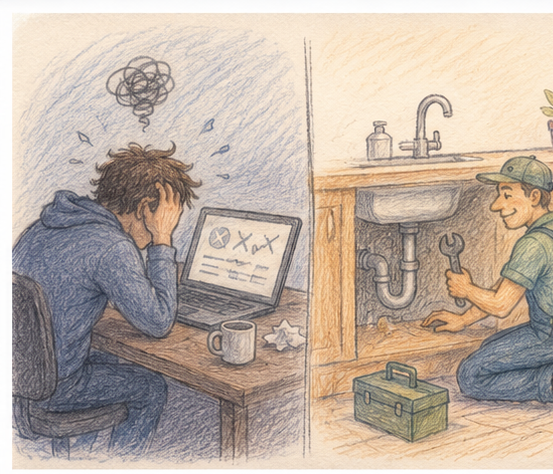
The plumber was right
A plumber fixed my sink in forty minutes while I spent two days on an allocator bug. The contrast changed how I think about useful work.
- ai
- work
- personal
Last March, my kitchen sink started making a sound like a small animal was trapped inside the wall. I am a renter, so this was technically my landlord’s problem. He was in Normandy, I was in Paris, and our message thread was not fixing anything.
I called Marc. He arrived in a van that smelled of coffee and PVC glue, looked under the sink, and said something in French that meant, roughly, “Yes, that is bad.” Forty minutes later, the sink worked. He had used three tools I did not know existed.
I went back upstairs to a custom memory allocator for an inference chip. I had already spent six hours chasing a segmentation fault. It was still broken.
The contrast was hard to ignore.
What Marc had that I did not
Marc did not need to explain the value of his work. Water was leaking; then it was not. The result was local, visible, and easy to judge.
Software work is rarely that clean. A good allocator can make an entire system faster and more reliable, but most people will never see it. A bad one may look fine until a particular workload, device, or memory pattern exposes the problem. The distance between the work and the person who benefits from it can be enormous.
Marc also had a kind of durability. People will continue to use pipes, and pipes will continue to fail. Better software may help him schedule jobs, price parts, or diagnose a problem, but someone still has to enter the kitchen and put a hand on the valve.
That does not make plumbing safe, easy, or well paid. It makes the source of its value unusually concrete.
The awkward part of my job
I build AI systems: runtimes, backends, robot policies, and the software around new hardware. Part of the goal is to make work that once required a specialist faster and cheaper.
That is useful. It is also difficult to discuss honestly when your own profession is made of tasks that software can increasingly assist with. Code generation is imperfect, but it already changes how much one engineer can produce. The first draft of a report, test, interface, or data analysis now costs less than it did a few years ago.
This does not mean every office job disappears. It does mean many roles will change, and some teams will need fewer hours to produce the same output. The pressure will not arrive as a dramatic robot takeover. It will look like a vacancy that is never reopened, a junior task absorbed by a tool, or a team of ten becoming a team of six.
Physical work has a different limit. A model can suggest how to repair a heat pump. It cannot yet carry the replacement unit upstairs, notice the corroded fitting the manual forgot to mention, and take responsibility for the result.
I still love my work. I like compilers. I like watching a biped robot learn to walk badly, then a little less badly. I like the moment a flat training curve finally moves. I simply no longer assume that this job will keep the same shape for the rest of my career.
What I tell friends
Friends ask whether they should learn to code. My answer has become less certain.
Coding is still useful. More important, though, is learning something with a result you can inspect and a customer who knows why it matters. That may be software close to hardware, but it may also be welding, nursing, repairing bicycles, growing food, installing heat pumps, or doing electrical work where someone must verify that the building will not burn down.
I am not romanticizing those jobs. Many are physically punishing, underpaid at the beginning, and hard to leave when your body gets tired. Their advantage is narrower: the failure is visible. A bad weld can be tested. A confident spreadsheet produced by an AI agent may survive until the quarter closes.
The useful distinction is not “manual work good, knowledge work bad.” It is whether your work stays connected to reality, judgment, and responsibility.
My own small hedge
I am not leaving AI systems. There is plenty of difficult, worthwhile work near chips, robots, energy, security, and other places where software meets hard constraints.
I did, however, sign up for a woodworking class in the 20th arrondissement. My girlfriend calls it a hobby. I call it a chance to become less useless around wood.
Marc charged 120 euros. The allocator took me another two days.
He had the better week.