Skip to content

// pytorch → photons

Software engineer · AI systems · Paris

I make PyTorch run on exotic hardware

Backends to firmware hooks. The unglamorous bit between a research chip and code someone can actually run.

scroll

// layer_00 · signal

About

AI systems, robotics, and software that has to touch hardware

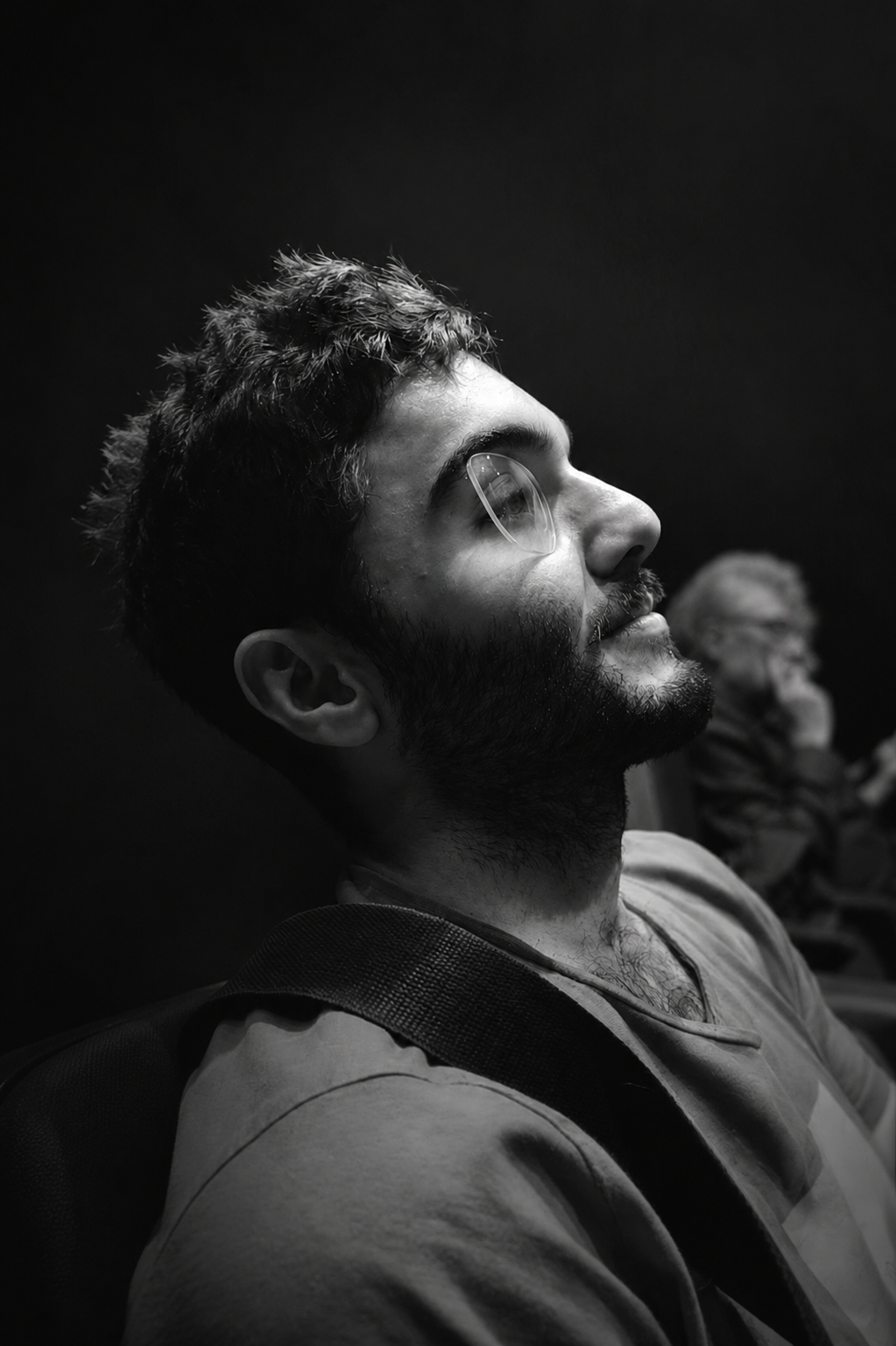
Portrait of Alhussein Jamil

Alhussein Jamil

AI systems, close to the metal

Paris, France

At Arago I work on backend paths, runtime dispatch, and launch code for a photonic AI accelerator.

Before that: walking robots and exoskeletons at Wandercraft, then computer vision for robotic automation at EyePick. École Polytechnique and Sorbonne Université in the mix.

I like code that has to deal with reality: hardware quirks, physics, latency, humans, bad assumptions. And yes, I vibe code too; I knew how to code before that became a personality trait.

// hidden_layers · experience

Where I've been useful

Accelerators, robots, computer vision, and prototypes that made it past the notebook

Where the work stopped being hypothetical.

Software Engineer, AI accelerators

Arago · Paris

  • PyTorch/ATen backend paths for a photonic AI accelerator: custom kernels, graph execution, and framework integration.
  • Runtime dispatch for graph partitioning, fast allocation, peer transfers, launch serialization, and concurrent queues.
  • Host code tied to firmware flows where launches become primitive device graphs for mono cores and sync points.
  • Hardware-adjacent work: custom ISA emission, driver interfaces, device setup, simulation, and validation.
See more

General-purpose silicon, PyTorch-first software. APIs, runtime, and firmware paths follow how ML teams already work.

Problem
Photon matmul is one kernel. Shipping means the full path: PyTorch in, runtime and firmware dispatch in the middle, tensors back out without breaking normal workflows.
What I built
Compiler lowering, host runtime, driver paths, fast allocation, device-to-device movement, launch queues, and firmware dispatch.
Tricky bit
Graph regions or single ops get placed on devices, split into primitive graphs, run on mono cores, and reported back to PyTorch through events. It still has to feel like a normal accelerator stack.
PyTorchRuntimeFirmwareAccelerators
GitHub ↗

Runtime map

PyTorch graph → compiler split → multi-device execution

01

PyTorch computation graph

input aten.mm norm gelu copy aten.mm add output
  • ATen ops form a real dependency graph
  • Tensor edges help decide what can run where
  • Acceleratable regions get pulled out for launch
02

Compiler + host runtime

01 Lower the graph
02 Place the work
03 Plan launches + transfers
03

Per-device execution

subgraph A

Device 0

node -> compute DAG

Execution sessions

queue 0 queue 1 queue 2

Device primitive graph

Control core
Laser compute unit
Sync + device events
PCIe / device interconnect
subgraph B

Device 1

node -> compute DAG

Execution sessions

queue 0 queue 1 queue 2

Device primitive graph

Control core
Laser compute unit
Sync + device events
04

Result

  • A launch can be a compiled subgraph or one PyTorch op
  • Firmware turns it into a primitive DAG for mono cores
  • Intermediate tensors move through PCIe or device links

Simplified map — public, generic terms only

Machine Learning Engineer

EyePick · Paris

  • Built computer-vision pipelines for real-time robotic automation in industrial, agricultural, and culinary settings.
  • Worked on image-based anomaly detection and classification for quality control.
  • Adapted ResNet-based models when YOLO-style detection pipelines were blocked by licensing constraints.

Reinforcement Learning Intern

Wandercraft · Paris

  • Trained RL control policies for the Cassie bipedal robot and the Eve exoskeleton.
  • Used NVIDIA Isaac Gym and Ray RLlib for parallel simulation and distributed policy training.
  • Worked on sim-to-real transfer with imitation learning, domain adaptation, and visual adaptation.

AI Algorithms Intern

Poppins (formerly Mila) · Paris

  • Implemented adaptive difficulty for a therapeutic game designed for dyslexic children.
  • Used clustering and gameplay metrics to adjust difficulty without asking children for explicit feedback.
  • Worked on both the algorithm and the game-side integration.

// weights · toolkit

How I got here

Skills, education, teaching, languages, and interests

Programming

  • Python
  • C++
  • C
  • OCaml
  • Java
  • C#
  • SQL

AI Systems

  • PyTorch execution
  • Graph lowering
  • Runtime work
  • Custom ISA
  • Kernels
  • Multi-core execution

Machine Learning

  • Computer vision
  • Reinforcement learning
  • Imitation learning
  • Sim-to-real
  • Model deployment

Robotics

  • NVIDIA Isaac Gym
  • Ray RLlib
  • Robotic control
  • Industrial automation
  • VR robot interfaces

Tools

  • Linux
  • Git
  • Docker
  • Debugging
  • HW/SW integration

Education

  • École Polytechnique

    Engineering Degree — MSc equivalent · 2020 — 2024

  • Sorbonne University — UPMC

    Master 2 — Intelligent Systems · 2023 — 2024

  • Lycées Buffon & Louis-le-Grand

    CPGE — MPSI → MP* · 2018 — 2020

Teaching

  • X-HEC Master

    Guest ML lecturer for engineering and business master's students.

  • Lycée Saint-Louis

    Oral examiner in mathematics for CPGE students.

Languages

French bilingual · Arabic native · English bilingual · Spanish intermediate

Interests

  • MMA
  • Puzzles
  • Violin
  • Climbing

// forward_pass · selected_work

Projects

Personal builds with real demos

open source · RL · mujoco

DropRL — bipedal locomotion

A Ray RLlib training pipeline on MuJoCo, with exportable policies for Cassie-style locomotion.

PythonRay RLlibMuJoCo
Problem
Get a Cassie-style biped walking in simulation without teaching it weird shortcuts.
What I built
A Ray RLlib training pipeline on MuJoCo, with exportable policies for Cassie-style locomotion.
Tricky bit
Reward goes up; the gait can still look wrong. Most of the time went into making the walk believable.
/ droprl · cassie · RL debug signals synced to video t = 0.0s
/ droprl · snake-v0 · AI agent iter 0 · reward 0.0 · score 0
star · policy π

capstone · VR · robotics

Affective Touch VR

Unity VR scene with Franka Emika arm control over Redis, hand-tracking calibration, and in-headset pleasantness/intensity ratings.

UnityVRFrankaRedis
Problem
Make a VR brush stroke line up with a real robotic touch setup closely enough for a psychophysics study.
What I built
Unity VR scene with Franka Emika arm control over Redis, hand-tracking calibration, and in-headset pleasantness/intensity ratings.
Tricky bit
Keeping rendering, robot/haptic hardware, and subjective ratings in sync without breaking the illusion.

Unity · VR · Franka Emika · Redis · Hand tracking

Touch simulation

Affective touch simulation

A brush stroke on a virtual hand, used as the main stimulus for the study.

Protocol & interface

Calibration

Hand-tracking calibration

The participant confirms hand poses, then follows a countdown before trials start.

In-VR ratings

Pleasantness & intensity UI

Ratings happen inside the headset, so the trial flow is not interrupted.

2d game · Unity · ADHD

Therapeutic puzzle game for an ADHD study

A Unity hub world with four puzzle mini-games, pixel-art rooms, fog-of-war, grid logic, and physics puzzles.

UnityC#Game design
Problem
Build a playable prototype to study how children with ADHD switch between exploration and exploitation.
What I built
A Unity hub world with four puzzle mini-games, pixel-art rooms, fog-of-war, grid logic, and physics puzzles.
Tricky bit
~200 solo hours across game loop, level design, mechanics, lighting, and the user-testing build.

Hub & level select

A temple hub with statue landmarks and portals into each mini-game.

Solo build · ~200 hours · made for ADHD user testing

4 mini-games

Color-coded crate puzzle

A Sokoban-style room: push crates onto matching colored altars.

Fragile bridge pathing

Numbered crates tell you how many tiles survive before the bridge gives way.

Ice sliding & hazards

Frictionless ice, spike traps, and very little room for sloppy moves.

Flashlight labyrinth

A circular maze where the fog-of-war only reveals tiles near the player.

game AI · pygame

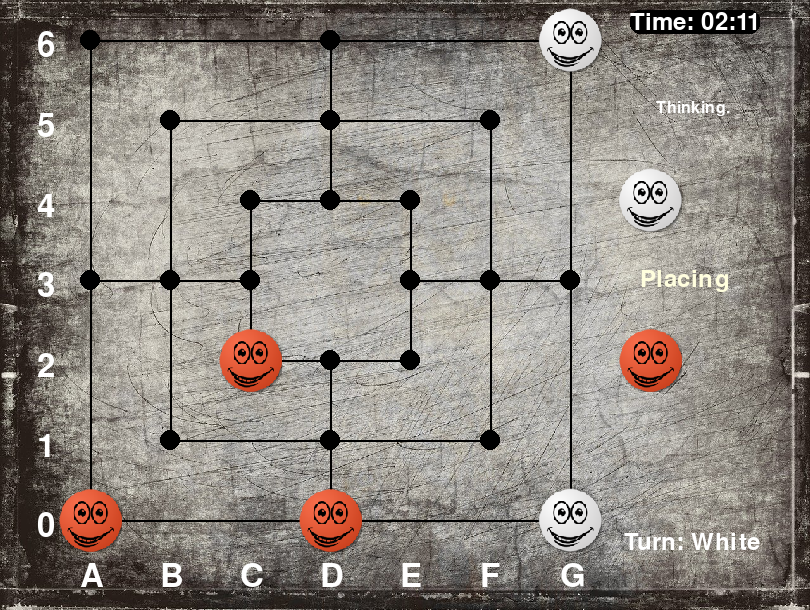
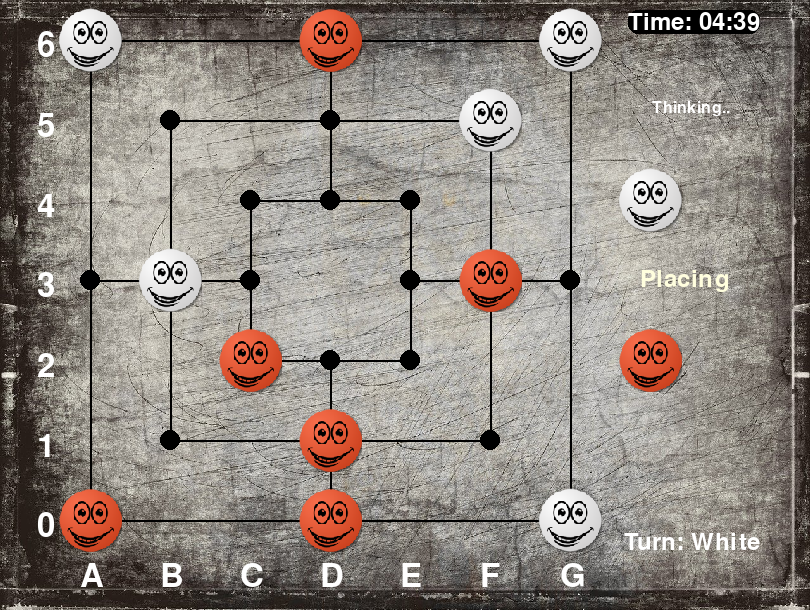
Noine — Nine Men's Morris

A full Pygame implementation with rules, UI, and a Minimax search bot.

MinimaxPygamePython
Problem
Build Nine Men's Morris end to end, including an AI that can actually play.
What I built
A full Pygame implementation with rules, UI, and a Minimax search bot.
Tricky bit
Move generation changes across placing, moving, and flying phases, so the search has to follow the game state closely.
/ noine — nine men's morris ·

click a point · form a mill to capture

original Pygame build

Noine board mid-game with orange and white pieces
Mid-game
Noine board during a mill capture
Mill phase

geometry · optimal transport

Convolutional Wasserstein distances

Python implementation of convolutional Wasserstein distances (Solomon et al., SIGGRAPH 2015).

PythonGeometry
Problem
Make optimal-transport distances practical on grids and meshes.
What I built
Python implementation of convolutional Wasserstein distances (Solomon et al., SIGGRAPH 2015).
Tricky bit
Using the structure of the domain instead of materializing a full cost matrix.

Barycenter demos

2D shape morph

Dots turn into a star through a convolutional Wasserstein barycenter on a 2D grid.

RGB image morph

Per-channel barycenters blend two color photos while keeping the mass structure readable.

3D voxel morph

A voxel dinosaur and a double torus interpolate through a lightly smoothed 3D barycenter.

Surface distribution transport

Heat-kernel Gaussians on a torus blend in 13 steps, so the spread and merge stay visible.

// latent_space · selected_projects

Smaller builds

Repos to learn, test, or get something out of my head

…and many more.

// render_pass · first_obsession

Early 3D

3ds Max experiments from when I was 10 to 15

Pixar-obsessed kid. Self-taught 3ds Max, built rooms and characters until I stopped. First screen craft I could not put down.

// output_layer · return

Contact

Projects, systems problems, strange technical knots